
How to Measure SEM ROI for Canadian Businesses: A City-by-City Guide to Setting KPIs That Drive Growth
Calgary | Toronto | Vancouver | Edmonton | Winnipeg | Ottawa | Halifax | Saskatoon | Regina | Montreal
Introduction: The $81 to $156 Question Every Canadian Business Owner Asks
You are a business owner in Calgary. You have just approved a $5,000 budget for Google Ads. Your competitor in Vancouver is spending twice that. Your friend in Winnipeg is spending half. All of you are asking the same question: "Is this actually working?"
Here is the uncomfortable truth most agencies will not tell you: a "good" return on ad spend in Toronto is different from a "good" ROAS in Halifax. The cost-per-click in Vancouver is not the cost-per-click in Edmonton. And if you are measuring SEM success with a one-size-fits-all metric, you are making decisions on bad data.
According to a comprehensive 2026 Canadian Local Search Benchmark study covering 257 cities and 41,842 businesses, paid-search cost-per-qualified-lead varies by 1.7 times across the country, from $81 CAD in PEI to $156 CAD in British Columbia. That is not a small margin. That is the difference between a profitable campaign and one that bleeds cash.
This guide is for Canadian small and medium-sized business owners who want to measure what actually matters. We will walk through city-specific benchmarks, the KPIs that separate winning campaigns from losing ones, and how Twenty32's integrated approach to marketing, operations, and finance helps you stop guessing and start growing.
Why Measuring SEM ROI in Canada Is Different
The Geography Problem
Canada is not a single market. It is a collection of distinct regional economies, each with its own competitive dynamics, cost structures, and consumer behaviours.
The numbers tell the story:
British Columbia: Average cost-per-qualified-lead (CPL) of $156 CAD, the highest in the country. Mobile search adoption has reached 74.1%, and voice search adoption is 11.2%, the highest nationally. This means your Vancouver campaign needs to be optimized for mobile and voice like nowhere else.
Toronto (Ontario): CPL averages $142 CAD, but that masks the reality that competitive keywords, like "Toronto plumber," can run $25 to $45 per click, while legal keywords can exceed $150 per click. The GTA is the most competitive paid search market in Canada, and competing on broad terms against national brands with massive budgets is a fast way to burn through your marketing budget.
Alberta (Calgary, Edmonton): CPL averages $134 CAD. The dominant high-LTV vertical is trades and home services, which means service-based businesses face specific competitive pressures. With net migration of people aged 25-44 into Calgary being the highest in Canada between 2021 and 2023, the customer pool is growing, but so is the competition.
Manitoba (Winnipeg): CPL is $97 CAD, significantly more affordable. The insurance and financial vertical dominates here. A Winnipeg campaign can achieve profitability at lower conversion rates than a Vancouver campaign.
Saskatchewan (Saskatoon, Regina): CPL averages $89 CAD, with agriculture services as the dominant sector. The organic search opportunity here is particularly compelling because the paid-search economics are less distorted by hyper-competition.
Atlantic Canada (Halifax, Moncton, St. John's, Charlottetown): CPL ranges from $81 CAD in PEI to $102 CAD in Halifax. Tourism and hospitality drive much of the search volume, and local-intent searches show the highest Map-Pack click-through rates in the country, at 46.3% in PEI.
What this means for you: If you are using a national benchmark to evaluate your local campaign, you are comparing apples to oranges. A "good" cost-per-acquisition in Winnipeg might be a "failing" cost-per-acquisition in Vancouver.
The "Fractional Marketing" Advantage
Before we dive into the metrics, let us address the elephant in the room: who is actually going to track all this?
Most small and medium-sized business owners do not have the time, the tools, or the training to build a proper SEM measurement framework. You are busy running your business. You did not get into this to become a Google Ads analyst.
This is where the "fractional" model, which Twenty32 champions across marketing, finance, and operations, becomes a game-changer. Instead of hiring a full-time marketing director at $100,000+ per year, you access senior-level expertise on a flexible, part-time basis. It is like having a head of marketing without the full-time expense.
Here is what a fractional marketing partner does that an agency often does not:
They sit on your side of the table. They are not trying to maximize your ad spend (like many agencies that charge a percentage of spend). They are trying to maximize your ROI.
They connect marketing to the rest of your business. At Twenty32, your fractional marketing team works alongside our accounting, operations, and HR specialists. Your SEM performance is discussed alongside your cash flow, your pricing strategy, and your operational capacity.
They build systems, not just campaigns. A good fractional partner sets up the tracking, the reporting cadence, and the decision-making framework so you can see, at a glance, whether your SEM investment is working.
One Twenty32 client put it this way: "With Twenty32 taking ownership of much of our operations, I have finally had time to focus on product development and strategy. It is like having a full team without the full-time expense, and they have made it easy." - Tim Fletcher
The SEM ROI Framework: What to Measure
Start With the End in Mind
The biggest mistake small business owners make with SEM is starting with tactics instead of outcomes. You do not want "more clicks." You do not even want "more leads." You want more of the right customers, at the right cost, generating the right lifetime value.
Here is a simple framework to get you there:
1. Return on Ad Spend (ROAS)
What it is: The total revenue generated divided by the total ad spend. A ROAS of 5:1 means you generated $5 for every $1 spent on ads.
Why it matters: ROAS is the most direct measure of whether your ads are profitable. It is also the metric that is most commonly misused.
How to use it in Canada:
For e-commerce or product businesses, ROAS is straightforward. Track revenue directly from the ad platform.
For service businesses (plumbers, lawyers, dentists), ROAS is harder because the sale does not happen online. You need to track calls, form submissions, and booked appointments through to closed revenue.
The City Factor: A 3:1 ROAS in Vancouver might be a success, while a 5:1 ROAS in Winnipeg might be underperforming, simply because the cost structure is different. The benchmark is your break-even ROAS, not a "standard" number.
2. Cost Per Lead (CPL) and Cost Per Acquisition (CPA)
What they are: CPL measures what you pay to generate a qualified lead (e.g., a phone call lasting more than 30 seconds, a form submission). CPA measures what you pay to acquire a paying customer.
Why they matter: If you do not know your CPL and CPA, you cannot evaluate your marketing efficiency.
How to use them:
Set up conversion tracking in Google Ads for calls, form submissions, and appointments.
Use call tracking (e.g., CallRail) to connect phone calls back to specific ad campaigns. This is especially important in Canada where many industries, including home services, healthcare, and legal, rely heavily on phone conversions.
Calculate your target CPA. What can you afford to pay to acquire a customer and still maintain your target profit margin? That is your benchmark.
The City Factor: According to the 2026 Local Search Benchmark, the national average CPL is $112 CAD, but this ranges from $81 CAD in PEI to $156 CAD in BC. Your target CPA must reflect your market, not a national average.
3. Click-Through Rate (CTR) and Quality Score
What they are: CTR is the percentage of people who click your ad after seeing it. Quality Score is Google's rating of your ad relevance (1 to 10), which affects your cost-per-click.
Why they matter: A high CTR and Quality Score mean you are paying less for each click. Google rewards relevance. In a high-cost market like Toronto, improving your Quality Score from 5 to 7 can reduce your cost-per-click by 30 to 50%.
How to use them:
Monitor your CTR by campaign, ad group, and keyword. Low CTR indicates your ads are not resonating.
Check your Quality Score in Google Ads. If it is below 7, you are paying too much.
The City Factor: In competitive markets like Toronto, improving Quality Score is essential for survival. Small businesses that compete on broad keywords against national brands get crushed; businesses that target specific neighbourhoods and high-intent keywords can compete effectively.
4. Conversion Rate
What it is: The percentage of ad clicks that result in a conversion (a lead or sale).
Why it matters: Your conversion rate determines how many leads you get from your clicks. A 2% conversion rate at 100 clicks equals 2 leads. A 4% conversion rate at 100 clicks equals 4 leads. Doubling your conversion rate is the same as doubling your traffic.
How to use it:
Optimize your landing pages. Your homepage is not a landing page. A dedicated landing page with one clear call-to-action consistently outperforms a homepage with multiple distractions.
Match your ad to your landing page. If your ad promises "Emergency Plumber in Calgary," your landing page should say "Emergency Plumber in Calgary" immediately. Inconsistency kills conversion.
The City Factor: In high-CPC markets, conversion rate optimization is not optional, it is survival. A Toronto business paying $30 per click with a 3% conversion rate has a $1,000 cost-per-lead. Improving the landing page to 5% conversion reduces that to $600.
5. Share of Voice and Impression Share
What they are: Impression share is the percentage of times your ad was shown out of the total times it could have been shown based on your budget and targeting. Share of voice is your ad's visibility compared to competitors.
Why they matter: If you are a Calgary home service business, your impression share tells you whether you are capturing your fair share of the local market.
How to use it:
Monitor impression share in Google Ads. If it is low, you either need more budget or better quality.
Track lost impression share due to budget. This tells you if you are leaving money on the table.
Track lost impression share due to rank. This tells you if your Quality Score needs work.
The City Factor: In a growing market like Calgary, where population of 25-44 year olds increased by nearly 10,000 through net migration between 2021 and 2023, capturing visibility early means capturing market share as the market expands.
6. Lifetime Value (LTV) and Customer Acquisition Cost (CAC) Ratio
What it is: LTV is the total revenue a customer generates over their relationship with your business. CAC is your total marketing and sales cost to acquire that customer. The ideal ratio is 3:1 (LTV is three times CAC).
Why it matters: This is the metric that connects marketing to business strategy. If your LTV:CAC ratio is too low, you are spending too much to acquire customers who are not valuable enough.
How to use it:
Calculate your average customer LTV. How long do customers stay with you? How much do they spend? This data often comes from your accounting system, not your ad platform.
Calculate your blended CAC. Include ad spend, creative costs, your time, and sales team costs.
Track the ratio over time. Are you acquiring more valuable customers or less valuable ones?
The Twenty32 Advantage: This is where the integrated model shines. At Twenty32, your marketing metrics connect to your financial metrics. We are not just tracking ROAS; we are tracking whether the customers you are acquiring are profitable over their lifetime. This requires close collaboration between marketing, accounting, and operations, a collaboration that is built into our fractional model.
City-Specific Benchmarks
Here is a quick reference guide to SEM benchmarks across major Canadian cities. Use these as a starting point, but remember: your industry, your offering, and your customer lifetime value are the ultimate benchmarks.
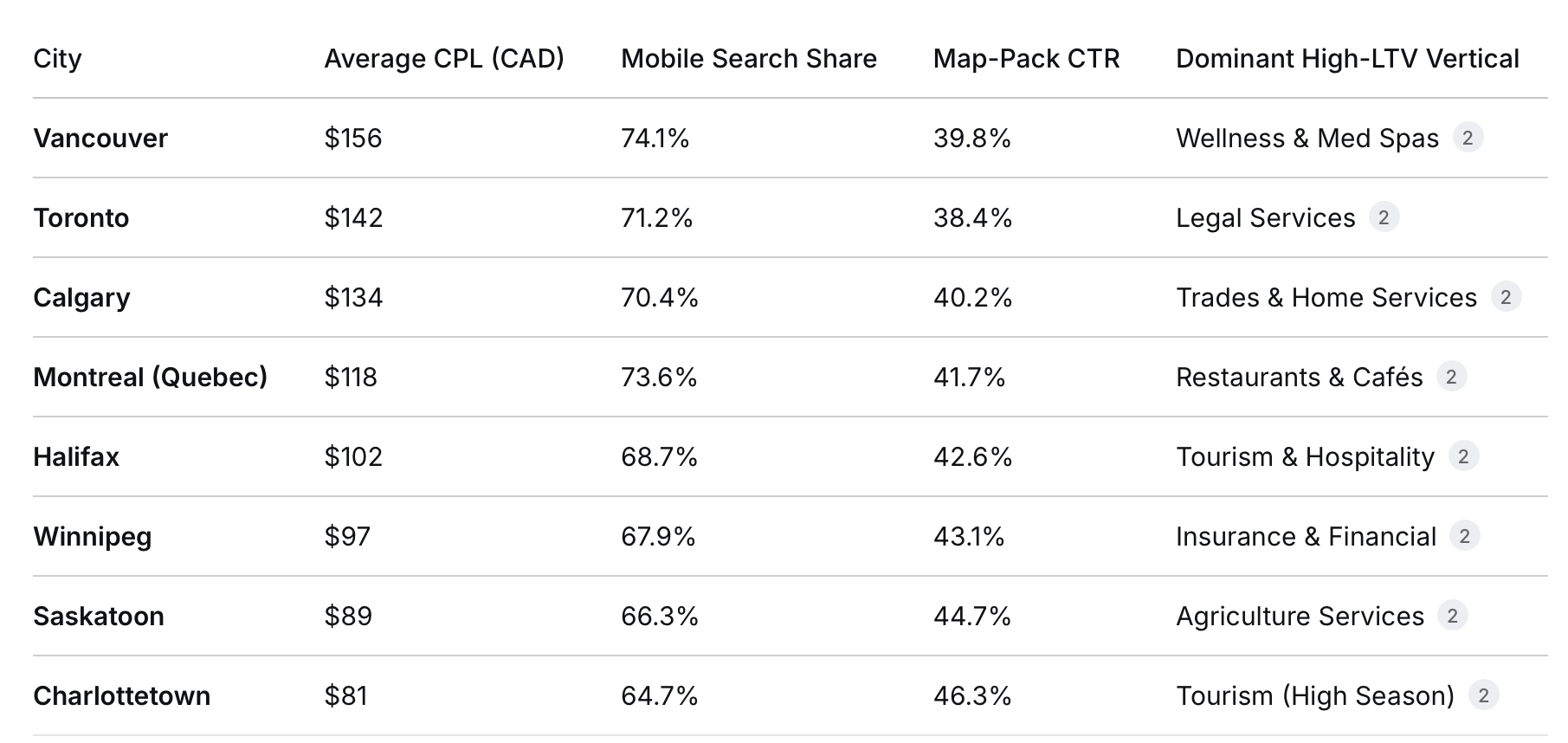
SEM benchmarks across major Canadian cities
What these numbers tell you:
If you are running SEM in Vancouver, you need a higher conversion rate or higher LTV to justify the cost. Mobile-first landing pages are non-negotiable since 74.1% of local searches are on mobile.
If you are running SEM in Calgary, focus on trades and home services keywords. Local SEO is especially powerful here because the Map-Pack CTR is 40.2%. Combine organic visibility with paid ads for maximum results.
If you are running SEM in Toronto, tight geo-targeting is essential. Do not compete across the GTA if you are a local business. Target specific neighbourhoods.
If you are running SEM in Atlantic Canada, organic search delivers higher CTRs than anywhere else, with Map-Pack CTR in PEI at 46.3%. Your paid budget goes further, but you need to think about seasonal patterns in tourism-heavy markets.
Real-World Example: A Calgary Home Services Business
Let us make this concrete.
The Business: A Calgary-based plumbing and HVAC company. Average ticket: $800. Customer lifetime value: $2,400 (three services over time). Target profit margin: 40%.
The Campaign: Google Search Ads targeting "emergency plumber Calgary," "HVAC repair Calgary," and neighbourhood-specific keywords.
The Metrics:
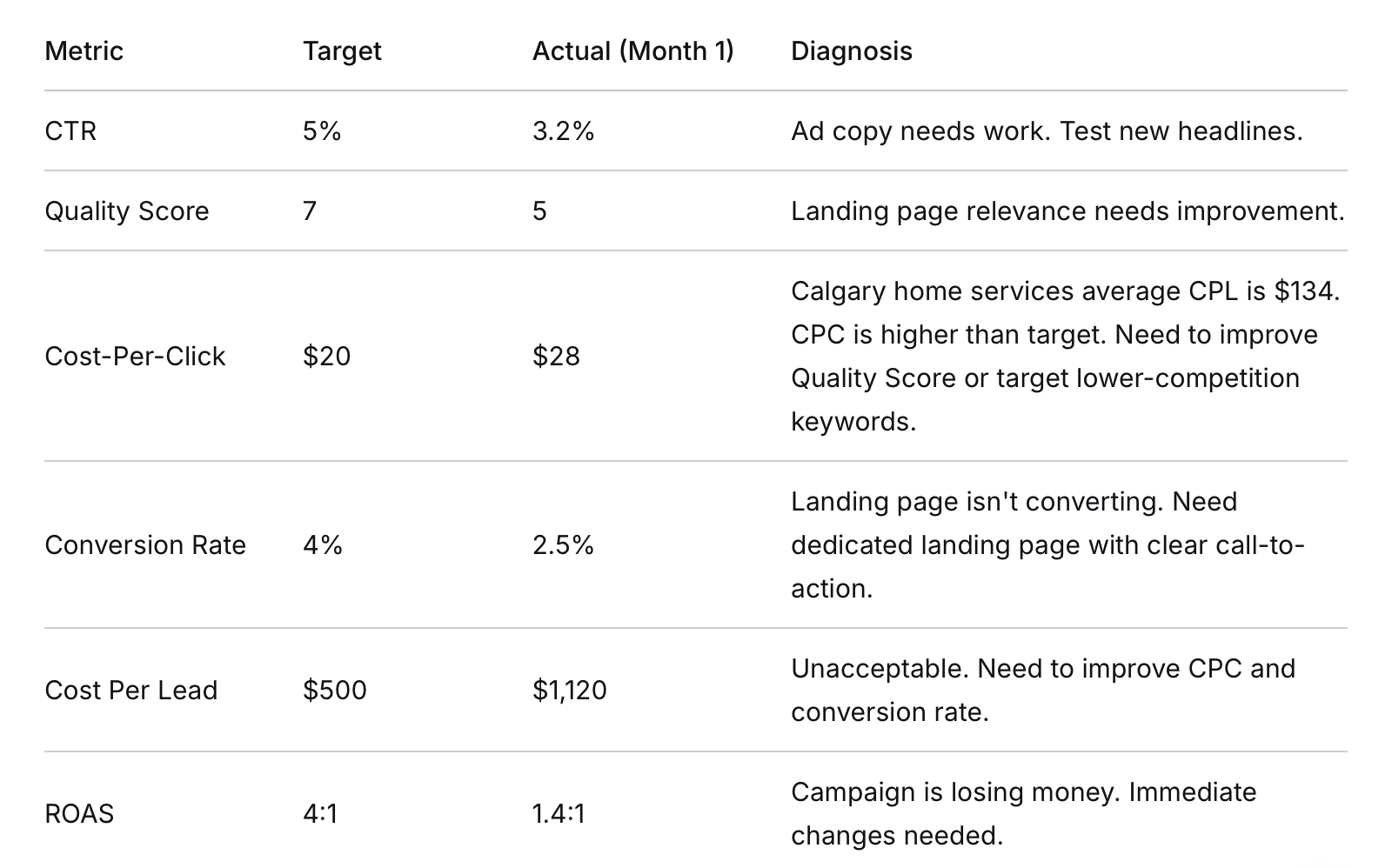
The Fix:
1. Refine keyword targeting. Stop bidding on broad "plumber Calgary" and target "emergency plumber NW Calgary" and "furnace repair [specific neighbourhood]." Lower competition equals lower CPC.
2. Improve the landing page. Create a dedicated page for each ad group. Match the exact language of the ad. Include a prominent phone number and emergency service badge.
3. Build the Quality Score. Use ad extensions (call extensions, location extensions) to improve relevance.
4. Set up call tracking. Many home service customers call directly. Without call tracking, the campaign might look like a failure when it is actually generating valuable calls
The Result: After 60 days of optimization, CPC dropped to $18, conversion rate increased to 3.5%, and CPL dropped to $515, close to the target.
The Twenty32 Role: At Twenty32, we do not stop at the marketing data. We connect the plumbing company's SEM performance to its financials. Is the cost-per-acquisition sustainable given the gross margin? Is the cash flow from new customers supporting the ad spend? Are we acquiring the right types of customers (e.g., emergency calls that lead to service contracts vs. one-off jobs)? This integration of marketing, accounting, and operations is what makes the fractional model so powerful.
Why Twenty32 Is the Right Partner for Canadian SMEs
1. You Need a Fractional Marketing Team That Understands Canada
The average agency treats all markets the same. They will run your Calgary campaign on the same template they use for Los Angeles. We do not do that. We understand that a Calgary business faces different competitive dynamics than a Toronto business or a Vancouver business. We understand the local search benchmarks, the industry verticals that dominate each market, and the seasonality of Canadian consumer behaviour.
2. You Need One Partner, Not Five
You need marketing. You need accounting. You need operations support. You need HR guidance. You do not need five different service providers giving you five different reports, five different invoices, and five different contact people.
At Twenty32, we are a single partner for all of it. Our fractional CFOs and Controllers work alongside our marketing team to ensure your ad spend is connected to your financial strategy. Our operations team helps you build the capacity to deliver on the new business you are generating. Our HR team helps you hire and retain the people you need to sustain growth.
One integrated team. One consistent philosophy. One relationship.
3. You Need to Focus on Your Core Business
SEM requires constant attention. So does bookkeeping. So does operations. So does HR. If you are trying to manage all of this yourself, you are not focusing on what you do best, running and growing your business.
What our clients tell us: "With Twenty32 taking ownership of much of our operations, I have finally had time to focus on product development and strategy. It is like having a full team without the full-time expense, and they have made it easy."
That is the Twenty32 difference. We do not just provide a service. We provide the capacity for you to do your best work.
Take the Next Step
Measuring SEM ROI is not complicated, but it is specific. It requires the right tracking, the right benchmarks, and the right connection between marketing and business strategy. If you are not confident in any of these areas, you are leaving money on the table.
Here is what you can do right now:
1. Conduct a Marketing Health Check. Review your current SEM campaigns against the metrics we have outlined. Where are the gaps?
2. Book a Consultation. At Twenty32, we offer a no-obligation, complimentary marketing clarity session. We will review your current performance and identify the biggest opportunities for improvement.
3. Consider the Fractional Model. If you are spending $3,000+ per month on SEM, you can likely afford fractional marketing leadership that will save you more than it costs. The math works.
Contact Twenty32 today. Let us build your integrated marketing, operations, and finance team. No agency fluff. No one-size-fits-all solutions. Just practical, local expertise that drives measurable results.
Twenty32 is a Calgary-based consulting firm serving businesses across Canada. We provide integrated marketing, accounting, operations, and HR services on a fractional basis. Our clients, from Vancouver to Halifax, appreciate having a single partner for their operational needs. We would be honoured to be yours.